Towers of ilium is in favor of the 2030 challenge. I'm also interested in squatting 1000 lbs. I don't expect either goal to be achieved, but the purpose of some goals is to remind us of the clear sunrise on the shores of some mythical paradise. We are an optimistic and ambitious species, able to deny thoughts of decay, destruction, and death in spite of the overwhelming evidence...Oh sod off on that topic--where was I?
Oh yes, architecture cannot achieve the the 2030 challenge--which requires that all buildings be carbon and energy neutral in sixteen years. Some building types, like high density residential, will come close to this goal, but I do not see how it can be applied to all structures. I will note several obstacles:
-Political: Promises can be made and broken by any government. More likely, most governments will ignore the challenge entirely because they will have other priorities.
-Energy Sources: Fossil fuels will be moderately priced and relatively abundant for the next several decades. Renewables will not have a price point that can consistently beat traditional energy systems.
-Architects, Clients, and Users: Building design and usage can only squeeze so much blood out of a thermodynamic stone. Renovation projects in particular do not allow for a blank slate retrofit of enclosures or systems to the degree that would meet the challenge. Most alterations are done piecemeal and on tight budgets.
Tuesday, February 11, 2014

Monday, February 10, 2014
icons and idols

I was going to comment on Mao's picture in Tiananmen Square, but I Google images gave me this bit of joy.
Anyway, the practice of putting up statues, pictures, and symbols of revered people is deeply human and has employed thousands of architects and artists over the centuries. Muslims tend to avoid it, but leaders of Muslim countries have no problem with depictions of their visage. It can be a dangerous thing to do. Warhol makes a good gesture here, but he was an expert.
The United States is monument crazy, but I like to think that we celebrate a broader range of people. Boston is littered with statues and memorials. With glacial pace, the identity of these people so honored drifts into obscurity. Eventually, most will achieve the anonymous status of Medieval sculptures.
Friday, February 7, 2014
contrived, tacked on, and still a good idea

Architects frequently operate as though they have a better grasp of the future than anyone else. This porch is a good idea--but it's also an afterthought, so it may look a little bit off. The service of architecture, however, is not to the precognitive abilities of the architect, but to the multitudes of end users. The architect will always forget something. The users will have changing needs. The world moves on.
Thursday, February 6, 2014
quality control and its limits
Any architect who has an ounce of experience with real-world projects should have an appreciation for the building trades. Good buildings depend on good craftsmanship more than on good design.The relationship between the artist/designer and the builder can be framed in rough mathematical terms:
A design that has a quality level of 7 that is executed by a craftsman who produces level 9 work can result in a level 8 final product.
A design that has a quality level of 9 that is executed by a craftsman who can produce level 7 work will result in a level 7 final product.
I stand by the claim that good design will not make a person into a better craftsman. An architect who wants level 9 and level 10 work should seek out clients and contractors who can deliver that. Trying to make chicken soup out of chicken shit is a futile and frustrating endeavor.
A design that has a quality level of 7 that is executed by a craftsman who produces level 9 work can result in a level 8 final product.
A design that has a quality level of 9 that is executed by a craftsman who can produce level 7 work will result in a level 7 final product.
I stand by the claim that good design will not make a person into a better craftsman. An architect who wants level 9 and level 10 work should seek out clients and contractors who can deliver that. Trying to make chicken soup out of chicken shit is a futile and frustrating endeavor.
Wednesday, February 5, 2014
what is a detail? (part IX)
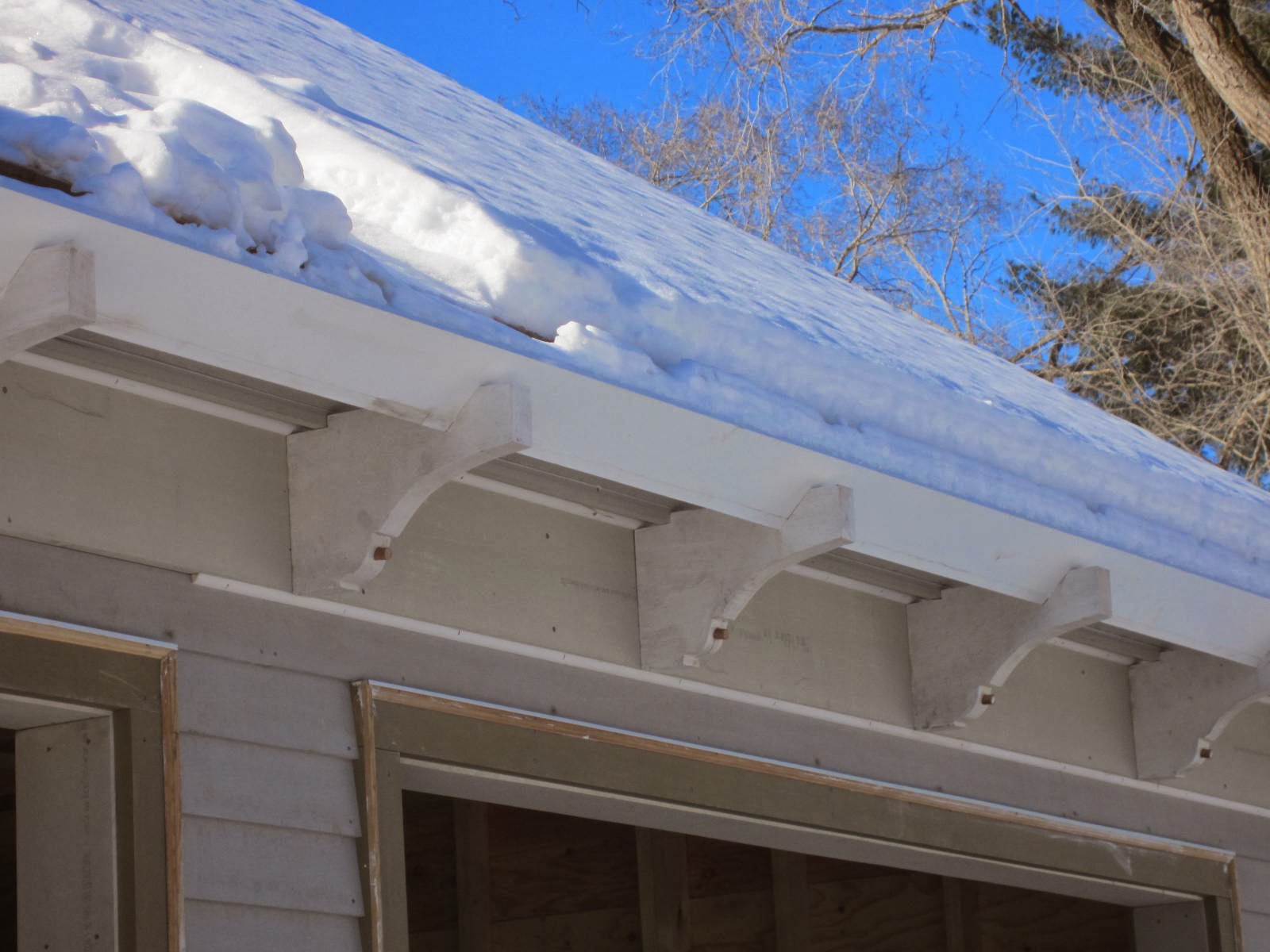
A gutter is a pretty straightforward item for a building, but it also represents an opportunity to make a design statement. That's what we tried to do here and I think it came out pretty well. The contractor even mentioned that it works.
At the most basic level, an architectural detail is a graphic depiction of how part A meets part B somewhere in a building. Many important details are hidden from view in the finished product, but if they aren't designed and executed properly then bad things can happen. Or not. It can be hard to predict sometimes.
Tuesday, February 4, 2014
the cape house is not dead

However, I am more convinced than ever that its viability as a house style is too compromised to make it anything more than a niche design product. Everybody likes Capes. Everybody liked Howard Johnson's. So it goes.
The design challenge that I cannot solve, and I doubt anyone can solve, is making a Cape work on the small lots that dominate American housing developments. The more interesting design challenge, which I haven't made a real effort to solve, is how to liberate the Cape design of a surplus of formal spaces.
Monday, February 3, 2014
monday observations

-I am opposed to the death penalty for Jahar Tsarnaev. A part of his soul died when he walked away from that deadly knapsack last April. What is left of him can contemplate the consequences of his actions for the next few decades. We have enough food to keep him alive.
-I have mixed feelings about Division I athletes bucking the authority of the NCAA. I derived some benefits from the inequities of that system.
-The absurdity of a 2024 Olympic Bid for Boston continues to aggravate me. Fortunately, other sensible people have raised opposition to it.
-I am considering several home improvement projects for 2014. I made an earlier resolution to avoid them, but reality has a way of changing my mind.
-Somewhere, there is good data on energy use of modern buildings. I'm too lazy to find it.
-The Cape House is dead.
-The random picture on this blog is from a post at BoingBoing.
Subscribe to:
Posts (Atom)